Compliance, Explained
SOC 2 vs ISO 27001: which one does your business actually need?
Inxtinct Editorial Team · Sep 28, 2026 · 5 min read
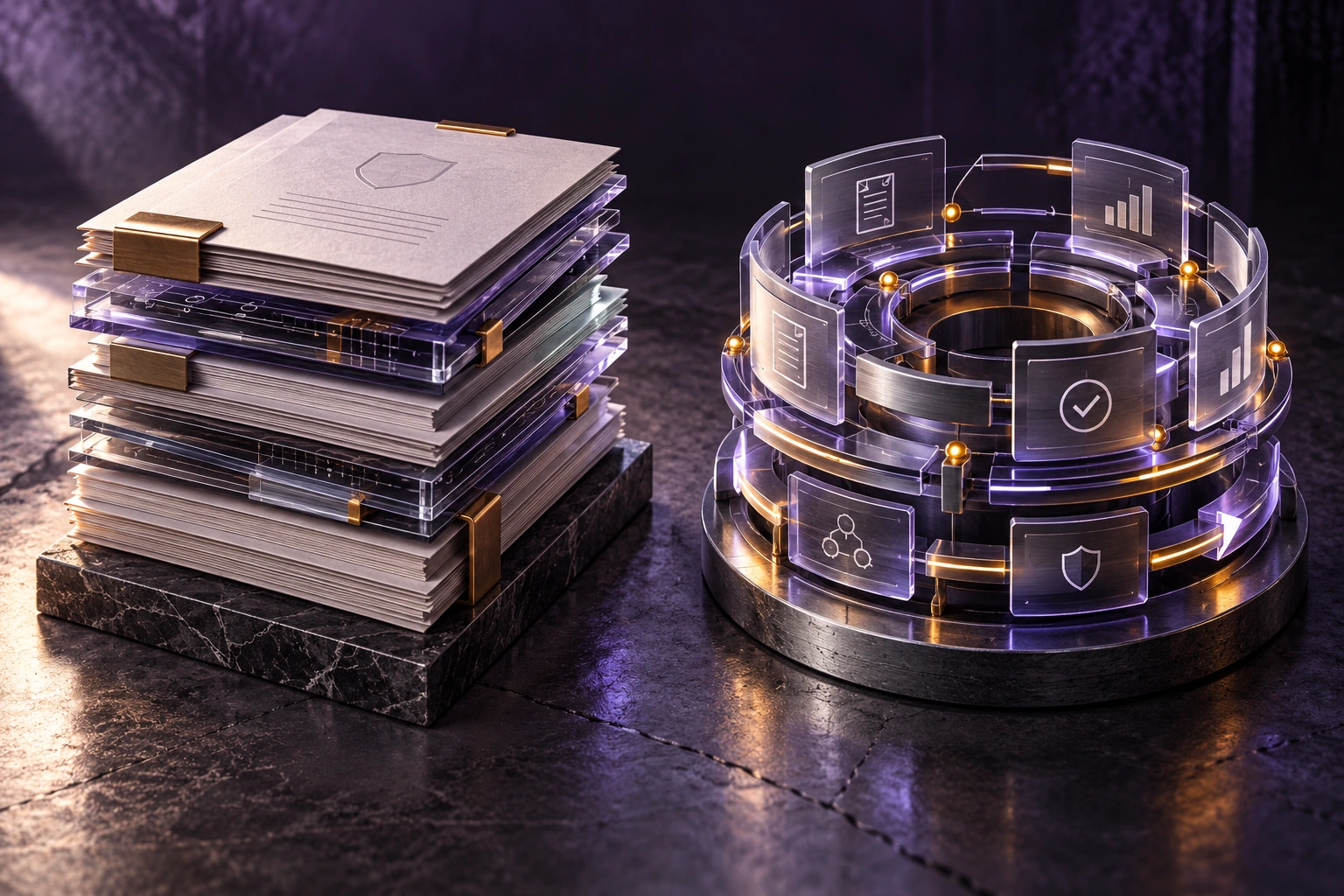
A startup is about to sign its first large customer. Procurement asks for a SOC 2 report. Another prospect has asked whether the company is ISO 27001 certified. Someone on the leadership team suggests getting whichever one is cheaper, then assuming it will satisfy both.
That is usually the wrong starting point. SOC 2 and ISO 27001 overlap in their concern for security controls, but they are different forms of assurance. Their practical value depends on what your customers are asking for and what the business is able to maintain.
What SOC 2 actually is
SOC 2 is an examination and report for service organisations based on the AICPA's Trust Services Criteria. Those criteria address security and, where relevant to the engagement, availability, processing integrity, confidentiality and privacy.
A SOC 2 Type 1 report describes controls at a point in time, while a Type 2 report examines the design and operating effectiveness of controls over a specified period. Buyers often care about Type 2 because it shows more than a snapshot, but their requirements vary.
A SOC 2 report is not a certificate. Be cautious about anyone who refers to a “SOC 2 certification” as though it were the same kind of independent certification as ISO 27001.
What ISO 27001 actually is
ISO/IEC 27001 specifies requirements for an information security management system, or ISMS. The management system asks the organisation to define scope, assess risks, apply and monitor appropriate controls and keep improving the way information security is managed.
Independent certification can demonstrate that the ISMS within the stated scope has been assessed against the standard. A certificate does not mean every product, supplier or office is automatically covered. Read the scope statement before making claims to customers.
ISO 27001 is often a natural fit when an organisation wants a durable security management framework that can support several customer and regulatory expectations. But it still requires real operational work, not just a policy folder.
Compare the questions each route answers
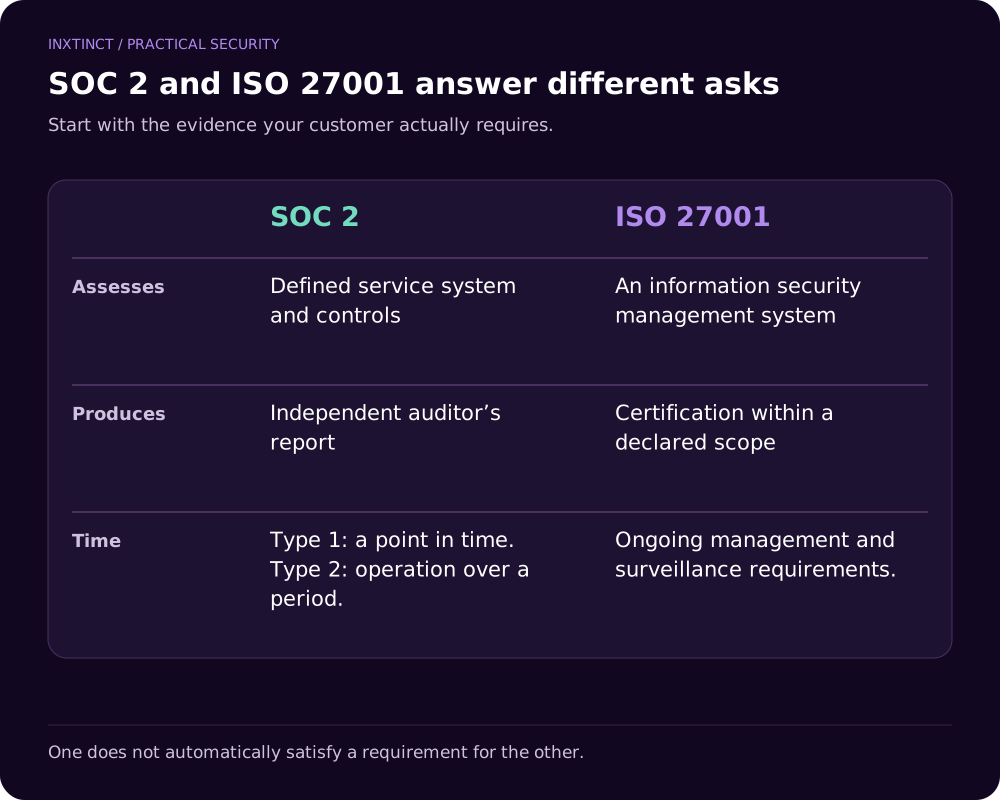
| Buyer question | SOC 2 | ISO 27001 |
|---|---|---|
| What is assessed? | Defined service-organisation system and controls | ISMS within the declared scope |
| What do you receive? | Independent auditor's report | Certification following an audit process |
| Does time matter? | Type 2 covers operation over a period | Ongoing management system and surveillance requirements |
| Typical buyer context | Customers requesting SOC reporting | Customers or tenders requiring an ISO standard |
| Is it a universal replacement for the other? | No | No |
The table is a guide to the nature of each route, not a prediction of what a specific customer's procurement team will accept.
Which should a UK business prioritise?
Begin with evidence from your sales pipeline. If a signed customer contract specifically requires a SOC 2 Type 2 report by a certain date, achieving ISO 27001 instead might not satisfy that obligation. Equally, an ISO certificate can be the explicit requirement for a tender or supplier programme.
Ask for the customer's exact wording and whether equivalent evidence is acceptable. Procurement teams sometimes use a standard questionnaire even where there is room to discuss alternatives.
Then consider your business model. A SaaS service provider may find SOC 2 reporting commercially important for US enterprise deals. A professional services organisation serving several markets may prioritise an ISO 27001 ISMS. Neither choice is determined solely by geography.
If both are important, coordinate the control work. Asset management, identity controls, change management, incident response, supplier review and risk assessment commonly support multiple assurance needs. Build one operating system for security rather than two competing sets of spreadsheets.
Estimate the work you actually need to do
Certification and examination costs are only part of the effort. Someone must own the controls, collect evidence, review access, demonstrate how changes are approved and respond when something is missing.
For a lean team, the most expensive choice may be to begin a rushed project without deciding its scope. That can leave everyone producing documents that don't correspond to how the business runs.
A sensible readiness sequence is: confirm buyer requirements, define scope, assess current controls, assign owners, close material gaps, organise evidence, then engage the relevant independent audit or certification providers.
Three mistakes worth avoiding
Mistake one: buying templates before deciding what applies. Policies should describe real responsibilities. A beautiful document claiming quarterly reviews won't help if nobody performs them.
Mistake two: treating all evidence as one-off paperwork. Controls need to operate. If you cannot show who approved a privileged account or how access was removed, a policy describing that process is incomplete evidence.
Mistake three: assuming assurance equals complete security. The exercise can improve discipline and customer trust. It does not eliminate threats or replace monitoring, secure engineering and good judgement.
What if neither is required today?
Don't buy an audit solely to display a badge on your website. Ask which customers you are pursuing, the contractual demands likely to arise and whether your security fundamentals need improvement first. In some cases, Cyber Essentials or a focused risk assessment is the sensible immediate step.
At Inxtinct, compliance support starts with the requirements and evidence you already have. The aim is to build a credible route to the assurance buyers actually need, without promising that one standard magically covers everything.