
Cybersecurity
You're Not Gullible. That's Exactly Why You Almost Fell For It.
Deepanjan Paul · Apr 17, 2026 · 3 min read

It arrived on a Tuesday afternoon. A WhatsApp message from what appeared to be HSBC Bank. Your bank. The logo was right. The sender name was right. The message said there'd been suspicious activity on your account and that your card would be blocked within two hours unless you verified your details through the link below.
You were between meetings. Your phone was in your hand. You almost tapped it.
If that sounds familiar, you're not alone, and you're not careless. You came close because the message was designed to work on someone exactly like you.
The people writing these messages are professionals
The image of a scammer is usually some variation of a teenager in a basement, firing off badly spelled emails and hoping someone bites. That image is roughly twenty years out of date.
Modern phishing operations run like businesses. They have designers, copywriters, and QA teams. They A/B test subject lines. They buy stolen data to personalise their attacks. They study the logos, the fonts, the tone of voice of the institutions they're impersonating. And they get it right.
The 2022 Twilio breach didn't start with malware or a zero-day vulnerability. It started with an SMS that looked exactly like a message from Twilio's own IT department, telling employees their passwords were about to expire. Eleven employees clicked it. That was enough.
These aren't lucky guesses. They're engineered outcomes.
Your brain is working against you
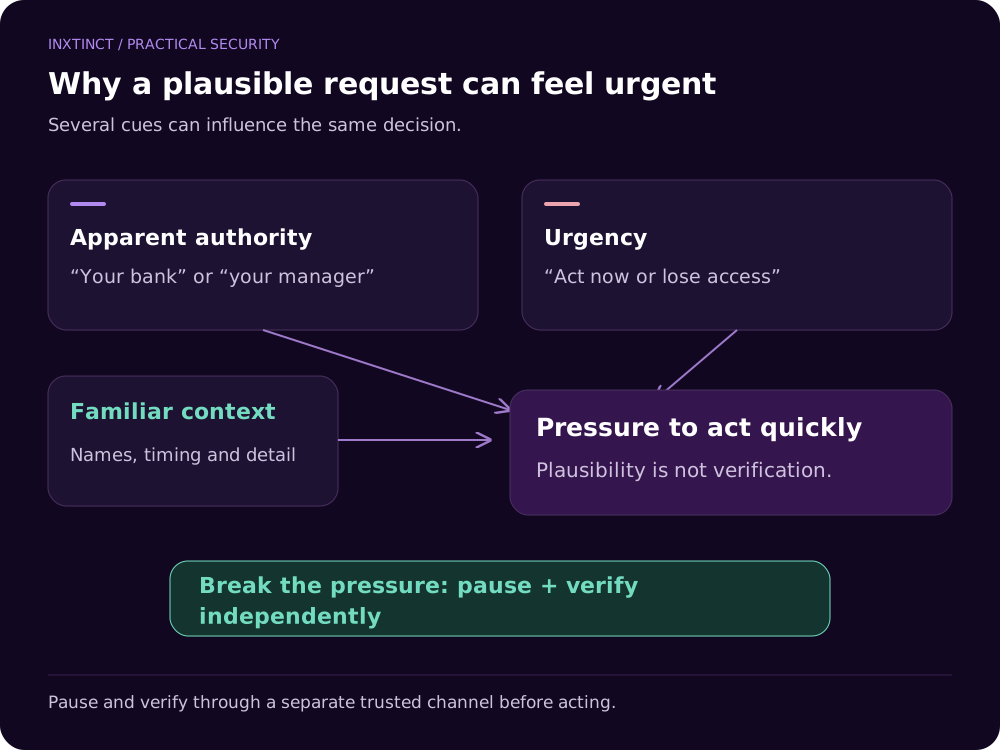
There's a reason urgency is the single most common element in phishing attacks. It's not lazy copywriting. It's applied neuroscience.
When you perceive a threat — your account being suspended, your card being blocked, a parcel you didn't know about — your brain shifts into a mode designed for quick action, not careful analysis. The prefrontal cortex, which handles critical thinking and pattern recognition, takes a back seat. The limbic system, which handles threat response, takes over.
In that state, you're not reading carefully. You're reacting. And the people who wrote that message knew that before they sent it.
Authority bias compounds this. When a message appears to come from your bank, your employer, or the government, your brain applies a shortcut: trusted source, fewer questions. This is efficient under normal circumstances. It's catastrophic when the source is fake.
The result is that the people most confident they'd spot a phishing attempt are, statistically, among the most likely to fall for a sophisticated one. Confidence reduces scrutiny. That's not a character flaw. It's how cognition works.
The mobile problem nobody talks about enough
On a desktop, you can hover over a link and see where it actually goes. The browser shows you the full URL. There are visual cues.
On a phone, you see what the sender wants you to see.
Most phishing now arrives via SMS, WhatsApp, Instagram DMs, and other mobile channels precisely because the attack surface is better. The screen is smaller. The URL is hidden behind a button. You're more likely to be distracted, moving, doing three things at once. And you're far less likely to stop, open a separate browser, and manually check whether the domain is legitimate.
This isn't a failure of awareness. It's a mismatch between the threat environment and the tools available to deal with it.
Vigilance was never a security strategy
For thirty years, the security industry's answer to phishing was education. Don't click suspicious links. Check the sender's address. Look for spelling mistakes.
The problem is that this puts the entire cognitive burden on you, every time, for every message, every day. Meanwhile, the attacks keep getting more convincing. It's not a fair fight, and framing it as a personal responsibility issue lets the industry off the hook for building tools that actually work.
The suspicious message you almost acted on that Tuesday afternoon shouldn't require you to pause, analyse, and make a judgement call under time pressure. It should be caught before it asks anything of you at all. That shift in thinking — from user vigilance to agent action — is what tools like Inxtinct One are built around.
That's not a utopian idea. It's an engineering problem, and it's the one worth solving.
Inxtinct One is an AI security agent built into your browser. Got something that doesn't feel right? A link, a message, a QR code? Share it and get a straight answer before you decide what to do with it.